WagNudge | Walking guide
Turn stressful walks into shorter, calmer practice sessions
If your dog pulls, lunges, or loses focus outside, start by finding a distance and pace where both of you can think. This guide gives you a five-minute reset and a gradual seven-session practice plan—without promising an instant fix or expecting every dog to progress the same way.
Use secure, well-fitted walking equipment. If you cannot control your dog safely, pause public practice and get qualified, hands-on support.
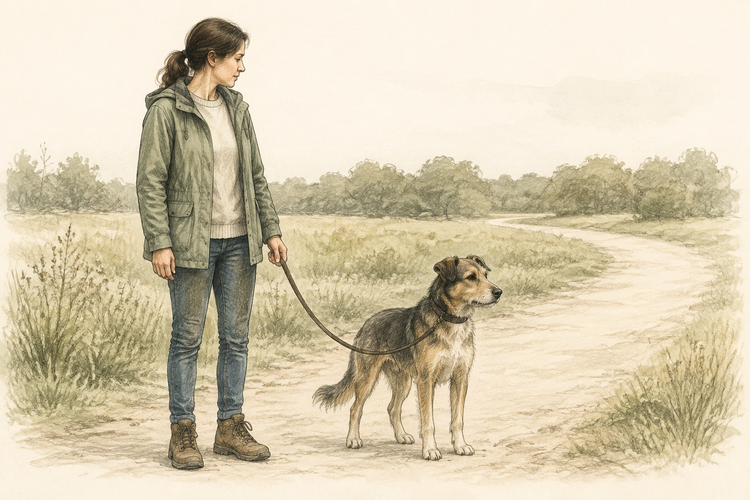
The approach
How this guide works
What you’re seeing
What kind of pulling are you seeing?
These patterns are observation prompts, not medical diagnoses or labels for your dog’s personality. More than one may apply on the same walk.
Excitement pulling
Common signs
Fast starts, a forward body, bouncing or whining, and difficulty slowing near the door or favorite places.
Possible reasons
Anticipation, a highly rewarding destination, or a routine in which pulling has repeatedly moved the walk forward.
Start here
Use the five-minute routine at the doorway or in a quiet area before attempting a full walk.
Trigger-focused lunging
Common signs
Staring, body tension, sudden acceleration, barking, or lunging toward dogs, people, vehicles, or other triggers.
Possible reasons
Excitement, frustration, fear, or insufficient distance. Similar-looking behavior can have different causes.
Start here
Begin with workable distance in Session 3 and the “another dog” scenario. Do not force a close pass.
Fear or avoidance pulling
Common signs
Pulling away, freezing and then rushing, lowered posture, repeated scanning, or trying to return home.
Possible reasons
A sound, surface, place, object, or social situation may feel unsafe or overwhelming.
Start here
Use the quietest possible environment and the shortest version of Session 1. Allow retreat and seek professional help if fear is severe.
Habitual constant tension
Common signs
The lead stays tight for most of the walk even when the environment appears calm.
Possible reasons
Walking speed mismatch, a long history of moving forward on a tight lead, or unclear feedback about what keeps the walk moving.
Start here
Practise the pause-and-release pattern from the five-minute routine in a low-distraction space.
Equipment or environment mismatch
Common signs
Pulling increases with a particular setup, equipment shifts or restricts movement, or focus disappears only in busy locations.
Possible reasons
Poor fit, discomfort, insufficient grip or control for the handler, or an environment that is too difficult for the current skill level.
Start here
Check fit before training and move to an easier location. Equipment can support practice, but it does not teach the skill by itself.
Do this today
An immediate 5-minute routine
Keep the setup easy enough that both of you can notice and repeat the useful moments.
Choose the environment
Use an indoor hallway, enclosed courtyard, private driveway with no moving vehicles, or a quiet stretch of sidewalk with enough room to turn away. Avoid the busiest part of the route.
Set the starting position
Stand still with your dog beside you or slightly ahead. Keep your shoulders relaxed and have small rewards ready before you begin.
Check the lead
Aim for a visible J-shape rather than a tight line. Hold the handle securely; do not wrap the lead around your hand.
Take the first steps
Say your normal walking cue once, then take two or three easy steps. Keep your pace natural rather than creeping.
Reward the useful moment
Mark and reward when your dog checks in, turns toward you, or takes a step while the lead is soft. Deliver the reward close to your side so the next step starts calmly.
Respond when the lead tightens
Stop moving or make a smooth turn away if stopping is unsafe. Wait for even a small release of tension, then mark and continue. Avoid repeated jerks or a constant backward pull.
Keep each round short
Work for 30–60 seconds, pause for sniffing or rest, and repeat up to five rounds.
Practise once or twice a day
A short session when neither of you is rushed is more useful than turning every necessary walk into a training test.
Practice sequence
A 7-Session Calm Walk Plan
Use these sessions in order, but repeat any session for as many days as your dog needs. This is a practice sequence, not a deadline.
Session 1 — Make check-ins easy
Goal
Create a simple pattern of looking back and moving together.
Environment
Indoors or a fenced, quiet private area.
Exercise
Reward voluntary check-ins, then add two or three loose-lead steps.
Duration
3–5 minutes total, split into short rounds.
Success marker
Three relaxed check-ins and several soft-lead steps.
If it goes wrong
Reduce movement, remove distractions, and reward one easy check-in before stopping.
Session 2 — Practise starts and stops
Goal
Begin moving without launching forward and pause without conflict.
Environment
A doorway, enclosed courtyard, or private driveway with no moving vehicles.
Exercise
Open the door only when you can do so safely, pause, take two steps, reward a soft lead, and reset.
Duration
5 minutes.
Success marker
Two calm starts in a row.
If it goes wrong
Move farther from the exit and rehearse the pattern before opening the door.
Session 3 — Work around one mild distraction
Goal
Notice something and return attention at a workable distance.
Environment
A quiet outdoor space where an ordinary, low-intensity distraction may appear naturally.
Exercise
When your dog notices it without escalating, mark the look back or turn away and create space.
Duration
5–7 minutes.
Success marker
One calm disengagement followed by a few soft-lead steps.
If it goes wrong
Increase distance immediately; do not wait for a lunge to prove the setup was too difficult.
Session 4 — Build short walking stretches
Goal
Link several successful steps together.
Environment
A familiar low-traffic route.
Exercise
Alternate 5–10 loose-lead steps with sniff breaks.
Duration
7–10 minutes.
Success marker
Three short stretches without continuous tension.
If it goes wrong
Shorten the stretch and reward earlier.
Session 5 — Practise a calm turn-away
Goal
Leave a distraction before tension escalates.
Environment
An open area with room to change direction.
Exercise
Say a consistent turn cue, move in a smooth arc, reward when your dog follows, then create distance.
Duration
5–8 minutes.
Success marker
Two responsive turns without dragging or lead jerks.
If it goes wrong
Practise the turn indoors again and use more distance outside.
Session 6 — Use the routine on a real route
Goal
Use the routine during a normal but shortened walk.
Environment
A familiar neighborhood at a quieter time.
Exercise
Combine calm starts, short loose-lead stretches, sniff breaks, and planned turn-aways. Do not deliberately seek out a trigger to test progress.
Duration
10–15 minutes, depending on your dog.
Success marker
If a mild distraction appears naturally, your dog can recover with added distance and return to a short loose-lead stretch.
If it goes wrong
End the training portion, take the easiest route home, and repeat Session 4 or 5 next time.
Session 7 — Review, do not test
Goal
Identify the conditions that make success repeatable.
Environment
Choose the most successful setting from the sequence; do not deliberately seek the hardest trigger.
Exercise
Repeat the best routine and record distance, duration, distractions, and recovery.
Duration
10–15 minutes or less.
Success marker
You can name one clear improvement and one variable to keep easy.
If it goes wrong
Treat the result as information, not failure. Return to the easiest successful session and seek help if safety is a concern.
In the moment
Real-world scenarios
Use immediate management first, then practise the skill later in an easier setup.
Pulling immediately after leaving home
What to do immediately
Pause before the door, create one soft-lead step, and use a short sniff break after a calm start.
What not to do
Let the first 30 seconds become a race or repeatedly yank backward.
How to practise later
Rehearse opening, pausing, and taking two steps when you do not need to go anywhere.
Lunging toward another dog
What to do immediately
Create distance in an arc, use a visual barrier if available, and leave before your dog is too overwhelmed to respond.
What not to do
Force a greeting, punish the reaction, or hold position close to the other dog.
How to practise later
Work at a distance where your dog can notice another dog and still disengage. A qualified professional can help set safe distances.
Chasing squirrels or moving objects
What to do immediately
Keep a secure hold, prevent further forward movement without jerking the lead, then turn away in a smooth arc before rewarding the first reorientation.
What not to do
Drop the lead, run after the trigger, or use sharp corrections.
How to practise later
Rehearse turn-aways with low-intensity moving distractions and increase difficulty gradually.
Pulling at road crossings
What to do immediately
Prioritize safety. Stop well back from the curb, shorten the working distance without tightening continuously, and cross only when you have control.
What not to do
Train in the roadway or delay crossing in an unsafe position.
How to practise later
Rehearse stop, check-in, and release cues away from traffic before using them at a crossing.
Losing focus in a new environment
What to do immediately
Move to the edge of the area, allow a short sniff-and-look period, then ask for one easy check-in.
What not to do
Demand the same duration you get at home or keep increasing cues when your dog cannot respond.
How to practise later
Visit for very short observation sessions at quiet times before attempting a route.
Pulling harder on the way home
What to do immediately
Slow the final block, add predictable sniff pauses, and reward short soft-lead stretches rather than fighting the whole return.
What not to do
Turn the last part into continuous backward pressure.
How to practise later
Walk short out-and-back segments, changing direction before the rush home becomes intense.
Avoid the friction
Common mistakes
Constant backward pulling
Continuous opposition gives the dog little information about the moment that works.
Training too close to triggers
Distance is part of the training setup, not a reward you must withhold.
Rewarding too late
Mark while the lead is soft or the check-in is happening, not after the dog has surged again.
Sessions that are too long
Stop while both of you can still repeat the skill.
Increasing difficulty too quickly
Change distance, duration, or distraction one at a time.
Training while rushing somewhere
Use management for necessary travel and practise separately when possible.
Inconsistent rules
Decide what makes movement continue and apply it calmly across handlers.
Expecting perfect walking immediately
Measure recoveries and short stretches, not an entire flawless route.
Track a trend
Progress checklist
Use this as a trend tracker, not a pass/fail test. Progress may vary by location, time of day, health, equipment, and trigger intensity. There is no fixed deadline.
Safety boundary
When to get professional help
Keep building the routine
Continue with the plan
Available on this page
7-Session Calm Walk Plan
Return to the structured practice sequence and repeat any session for as long as your dog needs.
Go to the planFrequently asked questions
-
Should I stop every time the lead becomes tight?
In a safe, low-distraction setting, pausing can make the consequence clear: tension does not move the walk forward, while a soft lead does. In traffic or another unsafe spot, turn or move to safety first.
-
What if my dog will not take food outside?
The environment may be too difficult, the reward may not be useful in that moment, or your dog may be stressed or uncomfortable. Increase distance, choose a quieter place, shorten the session, and consider veterinary or professional advice if the change is sudden or persistent.
-
Can a harness stop pulling?
A secure, well-fitted harness may improve comfort or handling for some dogs, but equipment does not teach loose-lead walking by itself. Fit, the individual dog, handler control, and the training plan all matter.
-
How quickly should this improve?
There is no universal timeline. Look for easier starts, more check-ins, shorter periods of tension, and faster recovery after mild distractions. Repeat easier sessions as needed.
-
Is this plan suitable for a dog that lunges aggressively?
General distance and turn-away principles are not an individualized safety plan. Work with a qualified professional and consult your veterinarian when relevant.
-
What should I do when I do not have time to train?
Use the quietest practical route, create distance early, keep the outing functional, and avoid testing difficult skills. Schedule a separate short practice session when you are not rushed.
Evidence-aware next steps
Direct answer
If the lead stays tight or your dog loses focus outside, begin in a quieter place where both of you can think. Reward brief moments of a softer lead, change one difficulty at a time and check that walking equipment fits without restricting ordinary movement. Equipment can support handling, but it does not teach loose-leash walking by itself.
Common mistakes to avoid
Avoid repeated lead jerks, forcing close passes, increasing distance and distraction together, or treating equipment as a behaviour guarantee.
Related guides
Next step
Try the short practice plan in a quieter place. Use the measuring and fit guides to check comfortable movement, and consider a harness only if it suits your dog and passes those checks.
Evidence and safety boundary
- Confirmed fact
- The cited source supports the topic named below; it does not describe or diagnose an individual dog.
- Practical guidance
- Use small, observable steps and adjust the routine to the dog in front of you.
- Safety limitation
- Stop when the dog is distressed or safety is uncertain, and seek appropriate professional help.
- Unknown / not provided
- No outcome, duration, diagnosis, product effect or individual response is guaranteed.
Or start with a different problem
Choose another challenge and continue with practical, problem-first guidance.
-
Enrichment
Boredom at Home
Discover enrichment ideas for dogs that need more meaningful activity.
Explore enrichment -
Puppy
Puppy Challenges
Start with practical guidance for biting, routines, and potty training.
View puppy basics -
Calm
Calm & Independence
Build supportive routines for dogs learning to settle and spend time alone.
Build a routine